


HOW DID ST. THOMAS ESTABLISH CHRISTIANITY ON THE INDIAN SUBCONTINENT TWO THOUSAND YEARS AGO?

Toronto, Canada, Jeffrey Suresh Ram, Editor, ReformAdvocate.Com
June 9, 2026
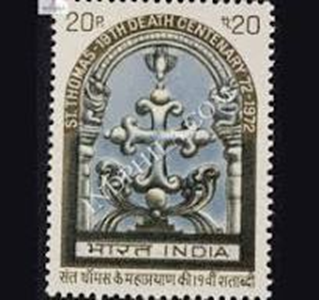
Photo: The Government of India issued its first commemorative postage stamp, valued at 0.15 paisa, honouring St. Thomas on December 2, 1964. This stamp was released to commemorate his status as the first apostle of Jesus Christ to India. India Post later issued a second commemorative stamp on July 3, 1973, valued at 0.20 paisa, marking the 19th death centenary of the apostle, which depicted the Cross of St. Thomas.
After the crucifixion of Lord Jesus Christ, his disciples were in hiding, fearing for their lives. But after meeting the resurrected Jesus, they were transformed. After his ascension, the disciples spread out across different regions to boldly carry out the Great Commission Jesus assigned: to make disciples of all the nations, baptizing them in the name of the Father and the Son and the Holy Spirit, and teaching them to observe all that Jesus had commanded. Apostle Thomas, one of the twelve disciples of Jesus, was entrusted with the responsibility to evangelize nations east of the Roman Empire, including regions associated with Parthia and India.
Apostle Thomas is also known as the Doubting Thomas because he initially doubted the resurrection of Christ and believed in the resurrected Jesus only after seeing his pierced side and the holes in his hands. Apostle Thomas is revered as a Saint by all Christians.
ST. THOMAS IN NORTH-WEST INDIA (NOW PAKISTAN)
After preaching in Ethiopia and some Middle East nations, St. Thomas arrived on the west coast of North India. The 3rd-century apocryphal text, the Acts of Thomas, states that the Apostle travelled to the Indo-Parthian Kingdom of Taxila around 40 AD before heading south to India.
He preached at the court of King Gondophares of Taxila. A legend states that the king gave St. Thomas a large sum of money to build a new palace for him because St. Thomas was a builder by profession. But the Saint gave away all the money to the poor and needy. When the king asked St. Thomas to show him the new palace, the Saint revealed that he had built the king’s palace in heaven. The furious king put the Saint in jail in order to execute him. But the king’s brother had a near-death experience and was miraculously revived. He told King Gondophares that he had seen the king’s palace in heaven in a vision. So, the king forgave the Saint and the entire kingdom converted to Christianity.
Taxila was a major centre of learning and Buddhism from the 5th century BC to the 6th century AD. According to local tradition, Saint Thomas built the first church in the Indian subcontinent at a site known today as the ancient archaeological city of Sirkap in Taxila, Punjab province, Pakistan. Since 1992, every year, during July 1-3, an annual pilgrimage and festival takes place here to celebrate and honour Saint Thomas.
A meter-high stone wall structure located inside the Sirkap Archaeological Site is known as the High Throne of St. Thomas (Sirkap). Local Christian traditions claim that Saint Thomas built it himself and used it to preach. It is designated as the “Palace of Saint Thomas” and protected under the Antiquities Act. It is a UNESCO World Heritage Site. The Taxila Museum, situated near the ruins, has an internationally recognized “holy bone” relic of the Saint.
HOW ST. THOMAS SPREAD CHRISTIANITY IN SOUTH INDIA
From North India, St. Thomas sailed to South India around AD 52. Indian Christian traditions believe that Saint Thomas landed at Muziris, near present-day Kodungallur on the Malabar Coast of southwestern India. This area was an important center of international trade for Arabs, Jews, Greeks and Indians. St. Thomas established the Church of the East in this region. Besides Kerala, he preached in Tamil Nadu and other parts of Southern India. In the first century AD, three Tamil kingdoms ruled in South India: the Chera, Chola, and Pandya dynasties. The Cheras ruled over Kerala, including the area surrounding the port of Muziris. The Cholas controlled eastern Tamil Nadu, and the Pandyas were the sovereigns of southern Tamil Nadu.
St. Thomas Preached Jesus' Message, Baptized New Believers, and Established Churches.
St. Thomas spread Christianity mainly through preaching, teaching, personal example, and the formation of local Christian communities
One of the strongest traditions among Indian Christians is that Thomas founded several churches in Kerala. These churches became centers of worship, teaching, and community life.
Tradition speaks of the "Seven and a Half Churches" established by St. Thomas. These include communities in places such as:
Kodungallur
Palayoor
Kottakkavu (Paravur)
Kokkamangalam
Niranam
Nilackal
Kollam
Thiruvithamcode
These early congregations helped Christianity take root in India and continue after Thomas's death.
St. Thomas Performed Miracles
At Palayoor, tradition claims he converted Hindu priests by successfully performing a challenge involving water being suspended in the air, after which the local temple was renovated into a church.
St. Thomas Trained Local Leaders
Tradition holds that he appointed elders and teachers to guide the churches after his departure. These leaders continued to teach the faith and organize Christian worship.
Journey to the East Coast of India
Tradition states that Thomas later travelled across southern India to the eastern coast, reaching the area around modern Chennai, formerly known as Madras. There, he continued preaching and gained additional converts.
The Martyrdom of Thomas
Christian tradition teaches that St. Thomas eventually faced opposition because of his preaching. Around AD 72, he was martyred near St. Thomas Mount, close to Mylapore in present-day Chennai, on the order of the Chola king.

Photo: Sign on the road to St. Thomas Mount reads “LAND OF MARTYRDOM OF ST. THOMAS”
The Legacy of Apostle Thomas
The influence of Thomas on the Indian subcontinent has been enormous. Today, millions of Christians in India, especially in Kerala, trace their spiritual heritage to him. The Saint Thomas Christian community has preserved ancient traditions, liturgies, and customs that connect modern believers with the earliest centuries of Christianity.
The Christians who trace their faith to him are known as the Saint Thomas Christians, or “Thomas Christians.” They are among the world’s oldest Christian communities.
Today, St. Thomas’s legacy is preserved mainly through the Syro-Malabar Catholic, Syro-Malankara Catholic, and Malankara Orthodox Syrian Churches, which trace their spiritual ancestry directly to his preaching.
St. Thomas's story also demonstrates the global nature of Christianity from its earliest days. The Gospel did not remain confined to the Middle East or Europe. Within a generation of Jesus' resurrection, Christian missionaries were already reaching distant lands and cultures.
Major Shrines of St. Thomas are:
St. Thomas Basilica in Mylapore, India
St. Thomas Syro-Malabar Church in Palayur, India
Basilica of St. Thomas the Apostle in Ortona, Italy
Related Blog:
PLEASE SHARE THE POST AND SUBSCRIBE TO REFORMADVOCATE.COM. ONLY ONE BLOG PER MONTH AND SUBSCRIPTION IS FREE-THANKS


Comments